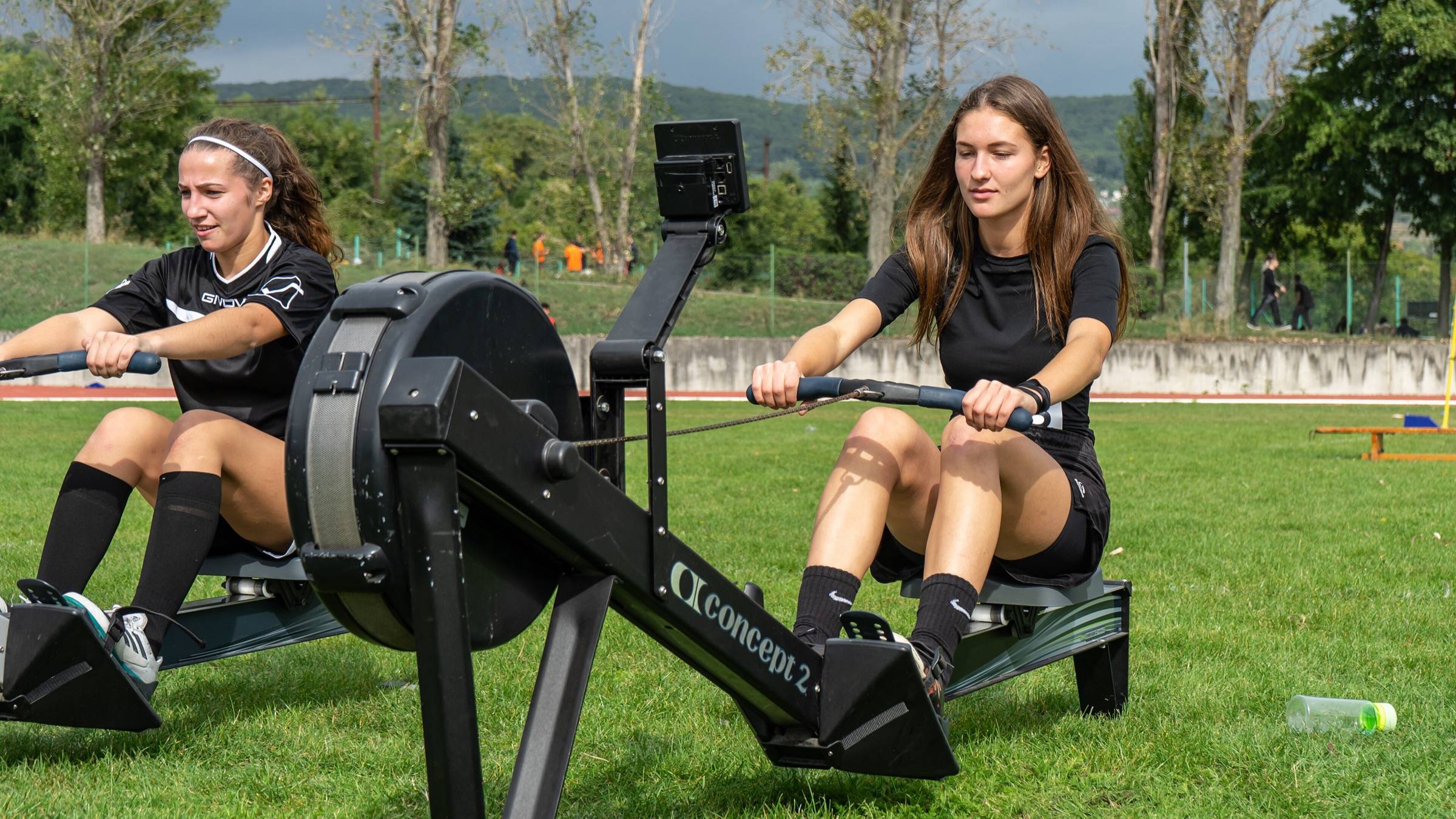
Rowing Machine Workouts: 10 Sessions at Your Level
These 10 rowing machine workouts cover what most people need, from your first row to a 2k test. Each comes at three levels with your own split, a stroke rate, and a version for rowers with no accurate monitor. New to rowing? Start with the first one.
10 workouts
3 levels
Your own splits
Any rowing machine
Sam Watson · Updated November 13, 2026
How to use this page
There are 10 different workouts below, numbered Workout 1 to Workout 10. Three quick steps set them up for you.
1 Pick your level
Every workout changes to suit your level: shorter and easier for beginners, longer and harder for advanced. Not sure? Choose Beginner.
2 Add a time you've rowed (optional)
Type a recent time, and every workout tells you the split to aim for: your pace per 500 m on the monitor. No time? Skip this step: each workout also gives the stroke rate and how hard it should feel.
Times like 7:30 or 7.30 both work. Your pace calculator result works here too.
3 Choose what you want (optional)
Pick how long you have and what you want from it, and only the workouts that fit stay on the page. Or leave both on Any and look through all 10.
Time
Goal
Times are for the workout itself, at your level, without the warm-up and cool-down. Need it all done in exactly 20 or 30 minutes? See our 20 and 30-minute workouts.
The workouts Showing all 10
Each chart shows the shape of the workout: the taller and darker a bar, the harder you row. Grey is rest or easy rowing.
Workout 1 · Technique drill
Learn the stroke
Short, easy pieces that make the stroke automatic: legs, body, arms on the way back; arms, body, legs on the way forward. Do this before anything hard.
Good for: Technique, Fitness
The workout · about 15 min
4 x 3 min, 1 min rest between
Your split
Add a result above
Stroke rate
18-20 a minute
How it feels
Easy. You can hold a conversation the whole way.
No monitor?
4 x 3 min at 18-20 strokes a minute, 1 min rest between. Easy. You can hold a conversation the whole way.
The workout · about 24 min
5 x 4 min, 1 min easy rowing between
Your split
Add a result above
Stroke rate
18-22 a minute
How it feels
Easy. You can hold a conversation the whole way.
One thing to focus on in each piece: legs first, then the body swing, then hands away before the knees bend, then a slow slide forward, then all of it together.
No monitor?
5 x 4 min at 18-22 strokes a minute, 1 min easy between. Easy. You can hold a conversation the whole way.
The workout · about 23 min
5 min, then 5 min, then 5 min, then 5 min
Piece
Your split
Stroke rate
5 min
Add a result
18-20
5 min
Add a result
20-22
5 min
Add a result
22-24
5 min
Add a result
24-26
The rate goes up by two each piece. Keep the same length and the same order of the stroke at every rate.
No monitor?
5 min at 18-20 strokes a minute. Easy. You can hold a conversation the whole way. 5 min at 20-22 strokes a minute. Easy. You can hold a conversation the whole way. 5 min at 22-24 strokes a minute. Comfortably hard. You can talk, but in shorter sentences. 5 min at 24-26 strokes a minute. Comfortably hard. You can talk, but in shorter sentences.
Coach's note: Push with the legs first, then swing the body, then pull the arms; come forward in the reverse order, and let the knees bend only once the hands are past them.
Warm-up, cool-down and the common mistake
Warm-up: 3 minutes very easy, building the stroke in stages: 10 strokes arms only, 10 arms and body, then full strokes.
Cool-down: 3 minutes very easy.
Common mistake: Bending the knees before the hands clear them on the way forward, so the handle has to go over your knees.
The session everything else is built on: a long, easy row that builds your heart and lungs without wearing you out. Most of your rowing should feel like this.
Good for: Endurance, Weight loss, Fitness
The workout · about 22 min
2 x 10 min, 2 min rest between
Your split
Add a result above
Stroke rate
18-22 a minute
How it feels
Easy. You can hold a conversation the whole way.
No monitor?
2 x 10 min at 18-22 strokes a minute, 2 min rest between. Easy. You can hold a conversation the whole way.
The workout · about 30 min
30 min
Your split
Add a result above
Stroke rate
18-22 a minute
How it feels
Easy. You can hold a conversation the whole way.
No monitor?
30 min at 18-22 strokes a minute. Easy. You can hold a conversation the whole way.
The workout · about 60 min
60 min
Your split
Add a result above
Stroke rate
18-22 a minute
How it feels
Easy. You can hold a conversation the whole way.
Hold 20 strokes a minute if you can.
No monitor?
60 min at 18-22 strokes a minute. Easy. You can hold a conversation the whole way.
Coach's note: Keep it easy enough to talk in full sentences, and use the time to make every stroke the same.
Warm-up, cool-down and the common mistake
Warm-up: 5 minutes building from very easy to the session's pace.
Cool-down: 3 minutes very easy, then stretch your hamstrings and hips.
Common mistake: Drifting too hard. If you can't talk in full sentences, slow the split and keep the stroke rate.
More on this workout: your zone 2 heart rate by age, three other ways to do zone 2, coaching as you row, and the questions people ask, on our zone 2 rowing page
Hard minutes with easy rowing between: a lot of work in 20 minutes, and the quickest way to feel fitter.
Good for: Fitness, Weight loss, Faster 2k
The workout · about 16 min
6 x 1 min, 2 min easy rowing between
Your split
Add a result above
Stroke rate
24-28 a minute
How it feels
Hard. A few words at a time; you could hold it for 10 to 20 minutes.
No monitor?
6 x 1 min at 24-28 strokes a minute, 2 min easy between. Hard. A few words at a time; you could hold it for 10 to 20 minutes.
The workout · about 19 min
10 x 1 min, 1 min easy rowing between
Your split
Add a result above
Stroke rate
28-32 a minute
How it feels
Very hard. No talking; each rep is a struggle by the end.
No monitor?
10 x 1 min at 28-32 strokes a minute, 1 min easy between. Very hard. No talking; each rep is a struggle by the end.
The workout · about 19 min
10 x 1 min, 1 min easy rowing between
Your split
Add a result above
Stroke rate
30-34 a minute
How it feels
Flat out or close to it, for a minute or two at most.
No monitor?
10 x 1 min at 30-34 strokes a minute, 1 min easy between. Flat out or close to it, for a minute or two at most.
Coach's note: Every hard minute at the same split. Keep rowing in the easy minute; don't stop.
Warm-up, cool-down and the common mistake
Warm-up: 5 minutes easy, with three 10-stroke pushes at the session's pace in the last 2 minutes.
Cool-down: 5 minutes very easy.
Common mistake: Sprinting the first minute and fading. Rep one should feel a little too easy.
More on this workout: three more HIIT sessions at your level, coaching for every stage of the workout, why HIIT works, and the questions people ask, on our HIIT rowing page
Workout 4 · Steady
30-minute rate ladder
Steady rowing where the stroke rate climbs in steps: 30 minutes that go quickly and teach you to change speed without losing your stroke.
Good for: Endurance, Fitness, Weight loss
The workout · about 29 min
4 min, then 3 min, then 2 min, then 4 min, then 3 min, then 2 min, then 4 min, then 3 min, then 2 min
Piece
Your split
Stroke rate
4 min
Add a result
18-20
3 min
Add a result
22
2 min
Add a result
24
4 min
Add a result
18-20
3 min
Add a result
22
2 min
Add a result
24
4 min
Add a result
18-20
3 min
Add a result
22
2 min
Add a result
24
Three rounds of 4 minutes at 18 to 20 strokes a minute, 3 at 22, 2 at 24, without stopping; 1 minute easy between rounds.
No monitor?
3 rounds of 4 minutes at 20 strokes a minute, 3 at 22 and 2 at 24, without stopping; 1 minute easy between rounds. Easy at 20, talking in shorter sentences at 24.
The workout · about 30 min
4 min, then 3 min, then 2 min, then 1 min, then 4 min, then 3 min, then 2 min, then 1 min, then 4 min, then 3 min, then 2 min, then 1 min
Piece
Your split
Stroke rate
4 min
Add a result
20
3 min
Add a result
22
2 min
Add a result
24
1 min
Add a result
26
4 min
Add a result
20
3 min
Add a result
22
2 min
Add a result
24
1 min
Add a result
26
4 min
Add a result
20
3 min
Add a result
22
2 min
Add a result
24
1 min
Add a result
26
Three rounds without stopping: 4 minutes at 20, 3 at 22, 2 at 24, 1 at 26.
No monitor?
30 minutes without stopping: 4 minutes at 20 strokes a minute, 3 at 22, 2 at 24 and 1 at 26, three times. Easy at 20, a few words at a time at 26.
The workout · about 30 min
3 min, then 2 min, then 1 min, then 3 min, then 2 min, then 1 min, then 3 min, then 2 min, then 1 min, then 3 min, then 2 min, then 1 min, then 3 min, then 2 min, then 1 min
Piece
Your split
Stroke rate
3 min
Add a result
22
2 min
Add a result
24-26
1 min
Add a result
26-28
3 min
Add a result
22
2 min
Add a result
24-26
1 min
Add a result
26-28
3 min
Add a result
22
2 min
Add a result
24-26
1 min
Add a result
26-28
3 min
Add a result
22
2 min
Add a result
24-26
1 min
Add a result
26-28
3 min
Add a result
22
2 min
Add a result
24-26
1 min
Add a result
26-28
Five rounds without stopping: 3 minutes at 22, 2 at 24 to 26, 1 at 26 to 28.
No monitor?
30 minutes without stopping: 3 minutes at 22 strokes a minute, 2 at 24 to 26 and 1 at 26 to 28, five times. Comfortable at 22, a few words at a time at 28.
Coach's note: When the rate goes up, keep the same push and length; the split should drop a little. If the rate rises and the split doesn't, you're rushing.
Warm-up, cool-down and the common mistake
Warm-up: 5 minutes easy.
Cool-down: 3 minutes very easy.
Common mistake: Getting the rate up by rushing forward on the slide instead of driving faster with the legs.
Pieces that get longer, then shorter: you learn to hold a pace, and the hardest part comes when you're already tired.
Good for: Fitness, Faster 2k
The workout · about 13 min
1 min, then 2 min, then 3 min, then 2 min, then 1 min
Piece
Your split
Stroke rate
1 min
Add a result
24-26
2 min
Add a result
24-26
3 min
Add a result
24-26
2 min
Add a result
24-26
1 min
Add a result
24-28
1, 2, 3, 2, 1 minutes, with 1 minute easy rowing between; the last minute a little faster.
No monitor?
1 min at 24-26 strokes a minute. Hard. A few words at a time; you could hold it for 10 to 20 minutes. 2 min at 24-26 strokes a minute. Hard. A few words at a time; you could hold it for 10 to 20 minutes. 3 min at 24-26 strokes a minute. Hard. A few words at a time; you could hold it for 10 to 20 minutes. 2 min at 24-26 strokes a minute. Hard. A few words at a time; you could hold it for 10 to 20 minutes. 1 min at 24-28 strokes a minute. Hard. A few words at a time; you could hold it for 10 to 20 minutes.
The workout · about 22 min
1 min, then 2 min, then 3 min, then 4 min, then 3 min, then 2 min, then 1 min
Piece
Your split
Stroke rate
1 min
Add a result
28-30
2 min
Add a result
28-30
3 min
Add a result
26-28
4 min
Add a result
24-28
3 min
Add a result
26-28
2 min
Add a result
28-30
1 min
Add a result
28-32
1, 2, 3, 4, 3, 2, 1 minutes, with 1 minute easy between; a little faster as the pieces get shorter.
No monitor?
1 min at 28-30 strokes a minute. Very hard. No talking; each rep is a struggle by the end. 2 min at 28-30 strokes a minute. Very hard. No talking; each rep is a struggle by the end. 3 min at 26-28 strokes a minute. Hard. A few words at a time; you could hold it for 10 to 20 minutes. 4 min at 24-28 strokes a minute. Hard. A few words at a time; you could hold it for 10 to 20 minutes. 3 min at 26-28 strokes a minute. Hard. A few words at a time; you could hold it for 10 to 20 minutes. 2 min at 28-30 strokes a minute. Very hard. No talking; each rep is a struggle by the end. 1 min at 28-32 strokes a minute. Very hard. No talking; each rep is a struggle by the end.
The workout · about 37 min
250 m, then 500 m, then 750 m, then 1,000 m, then 750 m, then 500 m, then 250 m
Your split
Add a result above
Stroke rate
30-34 a minute
How it feels
Flat out or close to it, for a minute or two at most.
The Pete Plan speed pyramid: 250, 500, 750, 1,000, 750, 500, 250 m at your 2k pace, with 1 minute 30 of very gentle rowing for every 250 m you just rowed. Speed up on the last two if you can.
No monitor?
Pieces of roughly 1, 2, 3, 4, 3, 2 and 1 minutes at close to your best 2k effort, 30 to 34 strokes a minute, with 1 minute 30 of very gentle rowing for each minute you rowed. The last two a little harder.
Coach's note: Each length has its own split. Hold it on the way up; on the way down, match the split you rowed for that length, and only beat it once you're past the top.
Warm-up, cool-down and the common mistake
Warm-up: 10 minutes easy, with two 20-stroke pushes at the session's pace.
Cool-down: 5 minutes very easy.
Common mistake: Sprinting the first short piece and paying for it on the longest one.
More on this workout: coaching for every piece, the rule for the way down, three more pyramids at your level, and the questions people ask, on our pyramid rowing page
Four hard 4-minute pieces with easy rowing between: the Norwegian interval session that raised VO2 max, the top limit of your engine, more than steady training did.
Good for: Fitness, Endurance
The workout · about 18 min
3 x 4 min, 3 min easy rowing between
Your split
Add a result above
Stroke rate
24-28 a minute
How it feels
Hard. A few words at a time; you could hold it for 10 to 20 minutes.
Three pieces to start; add the fourth when three feel steady, after about three weeks.
No monitor?
3 x 4 min at 24-28 strokes a minute, 3 min easy between. Hard. A few words at a time; you could hold it for 10 to 20 minutes.
The workout · about 25 min
4 x 4 min, 3 min easy rowing between
Your split
Add a result above
Stroke rate
28-30 a minute
How it feels
Very hard. No talking; each rep is a struggle by the end.
The Norwegian 4x4 as it was studied: every piece the same, 3 minutes easy between.
No monitor?
4 x 4 min at 28-30 strokes a minute, 3 min easy between. Very hard. No talking; each rep is a struggle by the end.
The workout · about 22 min
4 x 4 min, 2 min easy rowing between
Your split
Add a result above
Stroke rate
28-32 a minute
How it feels
Very hard. No talking; each rep is a struggle by the end.
Concept2's harder version: 2 minutes easy between, and a little harder each piece, so the last is your best.
No monitor?
4 x 4 min at 28-32 strokes a minute, 2 min easy between. Very hard. No talking; each rep is a struggle by the end.
Coach's note: Hard, not flat out. Each piece should end at 90 to 95% of your maximum heart rate, and you should finish the fourth feeling you could just about do a fifth.
Warm-up, cool-down and the common mistake
Warm-up: 10 minutes easy, building to the session's pace for the last minute.
Cool-down: 5 minutes very easy.
Common mistake: Going out at 2k pace in the first piece, or rowing harder to make your heart rate climb, and fading badly by the third.
More on this workout: the heart rate to aim for, coaching for every piece, three more VO2 max sessions at your level, and the questions people ask, on our 4x4 rowing page
Eight 20-second efforts with 10 seconds between, at a pace you can only just hold for all eight: four minutes that are as hard as rowing gets. For fit rowers, not your first week.
Good for: Fitness, Faster 2k, HYROX and CrossFit
The workout · about 7 min
8 x 20 s, 40 s easy rowing between
Your split
Add a result above
Stroke rate
28-32 a minute
How it feels
Very hard. No talking; each rep is a struggle by the end.
Tabata prep: hard, not flat out, with 40 seconds easy between. When that feels steady, cut the easy rowing to 30 seconds, then 20, then the real 10.
No monitor?
8 x 20 s at 28-32 strokes a minute, 40 s easy between. Very hard. No talking; each rep is a struggle by the end.
The workout · about 4 min
8 x 20 s, 10 s easy rowing between
Your split
Add a result above
Stroke rate
32-36 a minute
How it feels
Flat out or close to it, for a minute or two at most.
The Tabata: eight efforts at a pace you can only just hold for all eight. Faster than the split shown if you can hold it to the end.
No monitor?
8 x 20 s at 32-36 strokes a minute, 10 s easy between. Flat out or close to it, for a minute or two at most.
The workout · about 11 min
8 x 20 s, 10 s easy rowing between, then 3 min, then 8 x 20 s, 10 s easy rowing between
Piece
Your split
Stroke rate
8 x 20 s, 10 s easy rowing between
Add a result
32-36
3 min
Add a result
18-22
8 x 20 s, 10 s easy rowing between
Add a result
32-36
Two sets of 8, with 3 minutes easy between the sets. Expect the second set to be a little slower than the first.
No monitor?
Two sets of 8 x 20 seconds as hard as you can hold for all eight, 32 to 36 strokes a minute, with 10 seconds easy between efforts and 3 minutes easy between the sets.
Coach's note: Pick a split you can only just hold for all eight, and aim for the same meters every 20 seconds. Held it easily? Go faster next time. Faded after five? Start slower.
Warm-up, cool-down and the common mistake
Warm-up: 10 minutes easy, with three 10-stroke bursts.
Cool-down: 5 minutes very easy.
Common mistake: Letting the rate run past 36 with short, choppy strokes. Keep the full length of the stroke.
More on this workout: coaching for all eight efforts, what the original study really tested, three more sprint sessions at your level, and the questions people ask, on our Tabata rowing page
Eight 500 m pieces at or just faster than your 2k pace, with easy rowing between: the classic interval session for anyone training for a 2k.
Good for: Faster 2k, Fitness
The workout · about 19 min
4 x 500 m, 3 min easy rowing between
Your split
Add a result above
Stroke rate
28-30 a minute
How it feels
Very hard. No talking; each rep is a struggle by the end.
Four to start, at a split you can hold for all four, and the last one as fast as you can. Concept2's 500 m plan builds from here to eight over eight weeks.
No monitor?
4 x about 2:30 at 28-30 strokes a minute, 3 min easy between. Very hard. No talking; each rep is a struggle by the end.
The workout · about 22 min
6 x 500 m, 2 min easy rowing between
Your split
Add a result above
Stroke rate
30-32 a minute
How it feels
Flat out or close to it, for a minute or two at most.
Two minutes is short rest for 500s: aim for the slow end of your split, your 2k pace, and hold it for all six.
No monitor?
6 x 500 m, about 2 minutes each, at about your best 2k effort, 30 to 32 strokes a minute, 2 minutes easy rowing between. Hard, but the same effort every rep.
The workout · about 39 min
8 x 500 m, 3:30 easy rowing between
Your split
Add a result above
Stroke rate
30-34 a minute
How it feels
Flat out or close to it, for a minute or two at most.
The Pete Plan's classic, with 3 minutes 30 of very gentle rowing between. First time? Row the first seven at your 5k pace and the last as fast as you can, then aim for that average next time.
No monitor?
8 x 500 m, about 1 minute 45 each, a little harder than your 2k effort, 30 to 34 strokes a minute, 3 minutes 30 of very gentle rowing between. The same effort for seven, then everything on the last.
Coach's note: Every rep at the same split except the last, which you row as fast as you can. The first should feel too easy.
Warm-up, cool-down and the common mistake
Warm-up: 10 minutes easy, with three 20-stroke pushes at the session's pace in the last 5 minutes.
Cool-down: 5 to 10 minutes very easy.
Common mistake: Going out flat out in rep one and fading by rep four. The first strokes of every rep feel easy because you're fresh: settle to your split by stroke 10.
More on this workout: the split to aim for on your first go and after, how much rest to take, coaching for every rep, three more sessions near your 2k pace, and the questions people ask, on our 8 x 500 m page
One hard, even piece that tells you where you are, and sets your split for every workout on the site.
Good for: Faster 2k
The workout · about 5 min
1,000 m
Your split
Hard and even: hold one split the whole way
Stroke rate
24-30 a minute
Beginners test over 1,000 m: half the distance, the same lesson. Hard but even: the second 500 m faster than the first.
No monitor?
A test needs a monitor that measures distance. Without one, use the feel version of the other workouts; or row 5 minutes as hard as you can hold evenly, note how it felt, and repeat it in a few weeks.
The workout · about 8 min
2,000 m
Your split
Hard and even: hold one split the whole way
Stroke rate
26-32 a minute
First 2k? Start at a pace you know you can hold and push only after 1,000 m. Next time, start at that average.
No monitor?
A test needs a monitor that measures distance. Without one, use the feel version of the other workouts; or row 5 minutes as hard as you can hold evenly, note how it felt, and repeat it in a few weeks.
The workout · about 7 min
2,000 m
Your split
Hard and even: hold one split the whole way
Stroke rate
28-34 a minute
First 500 m 1 to 2 seconds slower than your target split, the middle 1,000 m on it, then empty the tank over the last 500 m. The pacing plan below has your numbers.
No monitor?
A test needs a monitor that measures distance. Without one, use the feel version of the other workouts; or row 5 minutes as hard as you can hold evenly, note how it felt, and repeat it in a few weeks.
Coach's note: First test: start at a pace you know you can hold and push only in the second half. Next time, start at that average. Then put your time in the box at the top of this page.
Warm-up, cool-down and the common mistake
Warm-up: 10 minutes, easy then building to moderate, with three 10-stroke pushes at the split you plan to hold near the end; 2 minutes very easy; start within 5 minutes. Advanced: 15 minutes, with a minute each at 26 and 28 strokes a minute and at your test rate (a minute easy after each) and one practice start.
Cool-down: 5 to 10 minutes very easy.
Common mistake: Sprinting past your split after the start. A few hard strokes to get the flywheel going are fine; settle by stroke 10, or you pay for it in the third 500 m.
More on this workout: a 500 m by 500 m pacing plan for any 2k time, coaching for every 500, how often to retest, what a good time is, and three more tests, on our 2k test page
Workout 10 · Row and run
HYROX row-run
1,000 m rows with a 1 km run after each: practice for HYROX's rowing station, on tired legs.
Good for: HYROX and CrossFit, Fitness
The workout · about 17 min
2 x 1,000 m, a 1 km run at an easy to moderate effort after each
Your split
Add a result above
Stroke rate
24-26 a minute
How it feels
Hard. A few words at a time; you could hold it for 10 to 20 minutes.
No monitor?
2 x about 5:30 at 24-26 strokes a minute, a 1 km run at an easy to moderate effort after each. Hard. A few words at a time; you could hold it for 10 to 20 minutes.
The workout · about 24 min
3 x 1,000 m, a 1 km run at race effort after each
Your split
Add a result above
Stroke rate
24-28 a minute
How it feels
Hard. A few words at a time; you could hold it for 10 to 20 minutes.
No monitor?
3 x about 4:30 at 24-28 strokes a minute, a 1 km run at race effort after each. Hard. A few words at a time; you could hold it for 10 to 20 minutes.
The workout · about 30 min
4 x 1,000 m, a 1 km run at race pace after each
Your split
Add a result above
Stroke rate
26-28 a minute
How it feels
Hard. A few words at a time; you could hold it for 10 to 20 minutes.
No monitor?
4 x about 4 min at 26-28 strokes a minute, a 1 km run at race pace after each. Hard. A few words at a time; you could hold it for 10 to 20 minutes.
Coach's note: Row the 1,000 m at a pace you could hold for 20 minutes, not a sprint: the race has three more stations after it.
Warm-up, cool-down and the common mistake
Warm-up: 5 minutes easy rowing and 5 minutes easy jogging.
Cool-down: 5 minutes walking or very easy rowing.
Common mistake: Getting off the rower and sprinting the run, then paying for it on the next row.
No workout matches those choices. Try a different time or goal, or set both to Any.
Intermediate, 4 rows: zone 2, the HIIT or the 4 x 4, the rate ladder, and a longer zone 2 row at the weekend.
Advanced, 5 or 6 rows: alternate a hard session (the pyramid, 8 x 500 m, 4 x 4 or Tabata) with a zone 2 row, and do the 2k test every six to eight weeks.
No monitor? Open "No monitor?" on any workout: it gives the same session by time, stroke rate and how it should feel.
Stay safe. If you haven't exercised for a while or have a medical condition, check with your doctor before you start (NHS). Stop and get help if you feel chest pain, unusual breathlessness or dizziness (American College of Sports Medicine). Build up gradually: leave the Tabata and the 2k test until you've rowed for a few weeks.
Start with short pieces: Concept2 suggests rows of 3 to 5 minutes with breaks, up to four, then building time and effort gradually (Concept2). Workout 1, Learn the stroke, is that session. Over time, build toward the guideline of 150 minutes of moderate activity a week (NHS). More in how long should you row for.
Is 20 minutes of rowing enough?
Yes, if it is hard enough and regular. The American College of Sports Medicine recommends at least 20 minutes of vigorous exercise on at least three days a week, or 30 minutes of moderate exercise on five (Garber and others, 2011). The 20-minute HIIT is built for exactly this, and our 20 and 30-minute workouts fit the whole session, warm-up included, into the time.
Is rowing HIIT?
Rowing is the machine; HIIT is how you use it. Hard intervals with easy recovery, like the HIIT, the 4 x 4 and the Tabata, are HIIT. A long easy row like the zone 2 row is the opposite, and just as useful.
Can rowing workouts help you lose weight?
They help, alongside diet. Research reviewed by the American College of Sports Medicine found that 150 to 250 minutes of moderate activity a week brings only modest weight loss, more brings more, and it works best with a moderate change in diet (Donnelly and others, 2009). A review of 13 trials found HIIT and steady training cut body fat by similar amounts, with HIIT taking about 40% less time (Wewege and others, 2017). More in rowing for weight loss.
Does rowing build muscle?
It works your legs, back and arms, but it is mainly endurance work. The American College of Sports Medicine recommends separate strength exercises for each major muscle group on two to three days a week (Garber and others, 2011). Turning the damper right up doesn't turn rowing into strength training: it just tires your muscles before your heart and lungs (Concept2).
Can I do hard workouts two days in a row?
Better not. Put an easy row or a rest day between hard sessions. The Pete Plan alternates every hard session with a steady one, slow enough to recover for the next day (The Pete Plan), and elite rowers spend more than half of their training at low intensity (Zhong and others, 2025).
What damper setting should I use?
Start at 3 to 5. A higher setting isn't a harder workout in any useful way: the effort comes from how hard you push, and the monitor measures it at any setting (Concept2).
My rower has no monitor, or a bad one. Can I still do these?
Yes. Every workout has a "No monitor?" version by time, stroke rate and feel. Moderate means you can talk but not sing; vigorous, only a few words without pausing for breath (NHS). No stroke rate on the screen? Count your strokes for 15 seconds and multiply by four.