Black Friday rowing machine deals are on: Hydrow, Ergatta, NordicTrack and more. See the deals
Rowing machine review
WaterRower vs Concept2: Which Rower Should You Buy?
By Sam Watson · Updated 15 November 2026
We earn a commission if you buy through the links on this page, at no extra cost to you.
I've rowed a Concept2 for years, and the first time I sat on a WaterRower I nearly didn't want to get off. Not because it was harder or faster. Because it was quiet, it sounded like water, and it looked like something you'd choose for a living room rather than hide in a garage. Then I looked at my split and realised I couldn't trust it, and that sums up this whole comparison. The Concept2 is the better machine for most people: it's $209 cheaper, it measures you honestly, and it sells used for most of what you paid. Buy the WaterRower if the rower is going to live where you live.
My verdict
Buy the Concept2 if you want the best value, numbers that mean something (a 2k, HYROX, CrossFit, Concept2's rankings), a machine you can split in two and move, or the best price when you sell it.
Buy the WaterRower if it's going in the living room or a bedroom, you row early while the house sleeps, or you'd rather look at oak than black aluminum. It also takes riders up to 700 lb.
Either is fine if you're new and rowing for fitness. Both are full-body, both last for years, and neither needs a subscription.
How they score on the scale we use for every rower (each has its full scorecard on its own review):
Concept2 RowErg
WaterRower Original
Overall
4.5
4.0
Rowing feel
5
4.5
Build quality
5
4.5
Screen and app
4
3
Workouts and coaching
3.5
3.5
Fit and comfort
5
4
Living with it
3.5
5
Value for the price
5
4
Customer service
5
3.5
The Concept2 wins on feel, build, screen, fit, value and service, and they tie on workouts. The WaterRower wins easily on living with it, and that one category is the whole reason to buy it.
At a glance
Concept2 RowErg
WaterRower Original
Normal price
$990 (tall legs $1,155)
$1,199 in oak (other woods $1,299 to $1,699)
Resistance
Air fan, damper 1 to 10
Water tank, no levels
Length in use
96 in (needs about 9 x 4 ft)
82 in (needs about 8.5 x 3.5 ft)
Stored
Splits in two: 25 x 33 in, 54 in tall
Stands on end: 17 x 22 in, 82 in tall
Weight
57 lb
64 lb empty, 101 lb filled
Max user
500 lb
700 lb
Inseam
Up to 38 in
Up to 37 in
Seat height
14 in (20 in with tall legs)
12 in (20 in with a HiRise kit)
Monitor
PM5, on an arm in front of you
S4 with Bluetooth, on the side
Subscription
None needed
None needed
Warranty
5 years frame, 2 years parts; transfers to a new owner
1 year, or 5 years frame and 3 years parts if you register it in the first year; doesn't transfer
Used asking prices
About $550 to $875
About $300 to $750
Prices from concept2.com and waterrower.com, 14 November 2026. Used prices are what sellers were asking on Craigslist in Boston, Chicago and Los Angeles the same week, not what they sold for.
How they feel to row
This is the part people argue about on forums, so here's what it's actually like. On the Concept2, the flywheel bites the moment you push with your legs, and the load builds exactly as hard as you drive. Row well and it feels like moving a boat; row badly and it feels jerky, which is honest if not always kind. On the WaterRower, the first stroke or two feel soft while the water gets moving, then it settles into a heavy, smooth swing, with the paddles churning the tank in front of you. There's no clunk and no harsh catch.
The WaterRower Original, here in walnut. The paddles spin in the clear tank, so the harder you pull, the harder the water pushes back. Photo: WaterRower.
There's nothing to set on a WaterRower. No damper, no levels. The harder and faster you row, the more the water pushes back, and it climbs steeply: WaterRower says doubling your speed takes about eight times the power. That makes sprints feel brutal in a good way. The water level changes how it feels, not how hard it is: more water feels like a heavier boat that takes longer to get going and carries on further, less feels lighter and quicker. Most people fill it to the line and leave it.
The Concept2 gives you a lever. The damper on the side goes from 1 to 10, and it works like gears on a bike: it changes how heavy each stroke feels, not how hard the workout is. Concept2 recommends 3 to 5, and that's where I row almost everything. If you've ever wanted a lighter feel for a long row and a heavier one for short sprints, that's something the WaterRower can't do mid-session.
Which is more like a real boat? Honestly, people disagree. Beginners usually say the water, because of the sound and the swing. People who've raced on the water usually prefer the Concept2's drive, and on rowing forums they say so loudly. I'm in the second camp for training and the first camp for a relaxed 30 minutes.
The feet. On the WaterRower, the footboard sits a bit higher and the foot pads closer together than on the Concept2. I noticed it on my first few rows, and a handful of owners and testers mention it too. Most people get used to it; if you have big feet or wide hips, it's worth trying one first.
Pick the Concept2 if you want to tune the feel and train hard. Pick the WaterRower if you want a smooth, forgiving stroke you don't have to think about.
Noise: the WaterRower's big win
An air rower is the loudest kind there is. Every stroke on my Concept2 makes a whoosh from the fan, a bit like a big desk fan winding up, and my dogs leave the room. The WaterRower makes the sound of moving water and not much else. I could row it with the TV on and still hear the TV.
Owners agree. Quiet is one of the things WaterRower owners praise most in their Amazon reviews, with very few saying otherwise, and every page that ranks for this comparison gives the WaterRower this round. Concept2 owners are split: plenty say it's quieter than they feared, and a good number say it's louder than they hoped. Neither maker publishes a decibel figure, so ignore any page that quotes one.
What that means in real life: a Concept2 is fine in a garage, a basement or a ground floor. In an upstairs apartment at 6 a.m., or in a bedroom with someone asleep next door, the WaterRower is the one you'll actually use.
Pick the WaterRower if anyone will be asleep, working or watching TV while you row.
Looks, space and storing it
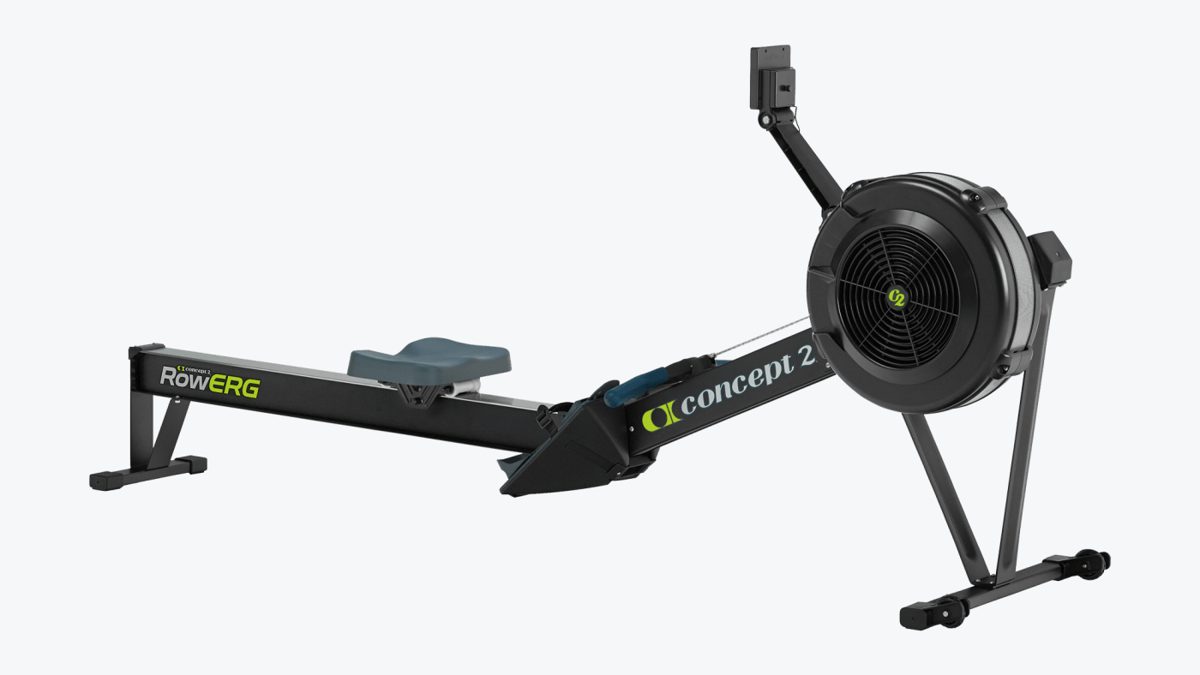
The WaterRower is made of solid hardwood in Rhode Island, finished in Danish oil, and it comes in six woods from oak to walnut. It looks like furniture because it basically is. The Concept2 comes in black, and it looks like gym equipment because it is. If the rower is going to be in a room you live in, that matters more than any spec.
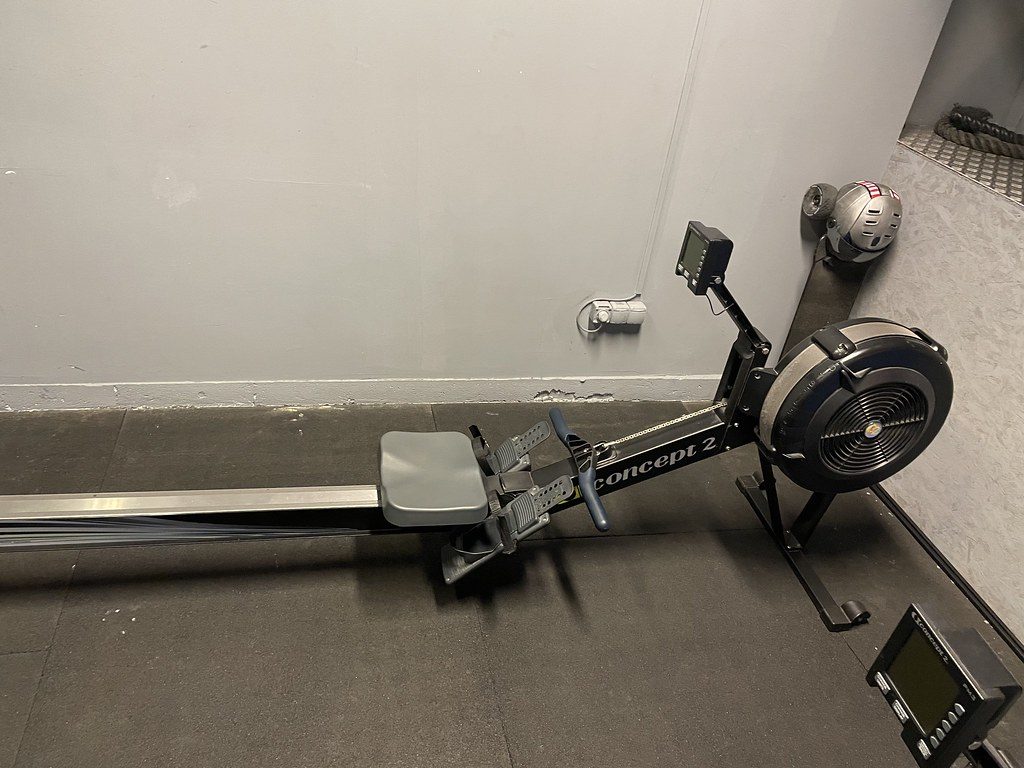
A Concept2 in a home gym, which is where it looks most at home. Photo: Start Rowing.
Stored, the WaterRower takes less floor. It stands on end, full of water, in about the floor space of a dining chair (17 by 22 inches), and it's designed to: you slide the seat forward, lift the back end and it tips up onto its wheels. It's about 101 lb filled, so it's a lift, not a flick, but it pivots rather than needing to be carried. It's 82 inches tall stood up, so check your ceiling and any shelves above it.
The Concept2 comes apart instead. Pull the release and it splits into two pieces with no tools, which takes me about 30 seconds: the front half rolls away on its wheels and the rail stands against a wall. That takes more floor than the WaterRower (about 25 by 33 inches), but it means you can carry it up stairs in two easy pieces, put it in a car, or take it to a friend's. Don't stand an assembled Concept2 on end; Concept2 says not to.
In use, the WaterRower is shorter: 82 inches against the Concept2's 96, and WaterRower suggests an area of 8.5 by 3.5 feet against Concept2's 9 by 4. Neither needs a power outlet: the PM5 runs on two D batteries and the S4 on four AAs.
Pick the WaterRower if it lives in a corner of a room. Pick the Concept2 if you move it often, or it's going in a car.
Your numbers: why WaterRower times look faster
This is the thing nobody tells you before you buy. The first time I rowed a WaterRower, my split looked better than anything I'd see on my Concept2 for the same effort. Lovely for the ego, useless for training.
Don't compare a WaterRower time with a Concept2 time. The S4 monitor works out your watts using the tank volume you type into it, and owners on the Concept2 forum, and reviewers who've rowed both, find WaterRower splits read faster. There's no reliable conversion. Compare yourself only with yourself, on the same machine.
The Concept2's PM5 is built to a recognized accuracy standard, and it measures the same way on every RowErg in the world. That's why a 2,000 meters on mine means the same as a 2,000 meters in a CrossFit box or a college boathouse, and why your times can go into Concept2's world rankings. If you train for a test, a race, HYROX or just a number to beat, that matters more than anything else on this page. Our rowing pace calculator works in Concept2 paces.
WaterRower's answer is the PowerPulley, a $300 option that measures your power directly with a sensor calibrated for each machine. It sends the numbers to an app on your phone or tablet rather than showing them on a screen of its own.
The monitors themselves are both plain. The PM5 sits on an arm right in front of you and shows pace per 500 meters, stroke rate, watts, calories and a curve of your stroke. The S4 sits low on the right-hand side, shows time, distance, stroke rate and your split, watts or calories, and has built-in interval and distance workouts. It does the job; it just isn't where your eyes naturally go.
Pick the Concept2 if your times matter to you. If they don't, this round doesn't either.
Apps and classes
Neither machine needs a subscription, and that's a big part of why I like both. You sit down, you row, it counts.
Concept2: the free ErgData app sends every row to your free online Logbook (and on to Strava or Garmin), with a Workout of the Day and its own leaderboard, plus world rankings and challenges through the year. The PM5 also works with more than 40 other apps, from Hydrow's own app to EXR and Kinomap, most of them paid. There's more in our guide to the PM5 and the free apps.
WaterRower: the S4 connects by Bluetooth to WaterRower Connect, free on iPhone and Android, with virtual races and leaderboards, and it syncs with Strava and Apple Health. Premium adds instructor-led classes, scenic rows and training plans from £4.99 a month (WaterRower quotes it in pounds, even on its US site). It also works with CITYROW ($29 a month or $299 a year), Peloton, EXR, Kinomap and others. If you want a proper screen, WaterRower will fit a 19.5-inch CITYROW touchscreen for $500 more.
The Concept2 has the bigger community and more apps. The WaterRower's paid classes are cheap. If you want a coach on a big screen every session, though, neither is really the answer: look at a Hydrow or the Ergatta, which is built by WaterRower and adds games to the same kind of water tank.
Looking after them
Both are low-maintenance, but the jobs are different, and a lot of the pages that rank for this get the WaterRower's wrong.
WaterRower: drop one of WaterRower's purification tablets in the tank every 3 to 6 months (every 3 to 4 if it sits in sunlight), or sooner if the water clouds. Never chlorine or bleach: WaterRower warns against both, and using a product it hasn't approved can void the warranty. Keep dust out of the belt area, wipe the rails, and dust or polish the wood now and then. If algae ever gets going, you empty the tank, flush it and refill.
Filling it is the job owners complain about most. You lay it flat and siphon water in from a bucket raised on a chair with the pump in the box. It's slow, and it's easy to slosh water on the wood. The good news is you do it once when it arrives and then rarely again. Fill to the line: overfilling past the maximum can void the warranty too.
Concept2: oil the chain every 50 hours of rowing (the warranty asks for it), wipe the rail, and vacuum the dust out of the flywheel housing now and then. Parts are cheap and you fit them yourself. Our Concept2 maintenance guide has the routine.
What they cost, and what you get back
The Concept2 is $990 plus $55 shipping. The WaterRower Original is $1,199 in oak, with shipping worked out at checkout, and up to $1,699 in walnut. Neither costs anything after that. So the gap is $209 or more on day one, and it grows when you sell.
Resale. When we looked in November 2026, used wooden WaterRowers with the S4 monitor were mostly listed at $300 to $750 on Craigslist, about a quarter to 60% of today's prices. Used Concept2s with a PM5 were listed at $550 to $875, about 55 to 90% of a new one. Asking prices aren't sale prices, but the pattern is clear: a Concept2 holds its value better than almost anything in a home gym.
The warranty catch. WaterRower's headline is 5 years on the frame and 3 years on parts, but that's only if you register the rower within the first year. Otherwise it's 1 year. It doesn't transfer to a second owner, you pay the shipping to send a part back, and it's void if you overfill the tank or use the wrong water treatment. Concept2 gives 5 years on the frame and 2 on everything else, including the monitor, and it does transfer, which is one more reason used ones sell so well. If you buy a WaterRower, register it the day it arrives.
Returns. Concept2 gives you 30 days to return it for a refund of the machine's price, and you pay shipping both ways. WaterRower takes returns at its discretion, may charge a 15% restocking fee, and you pay the shipping both ways.
Over five years, with no fees on either, the Concept2 costs about $1,045 and the WaterRower about $1,199 plus shipping. Sell either one after that and the Concept2 probably costs you less again.
Who should buy which
Best for most people
Concept2 RowErg
$990standard legs at Concept2 and Rogue; tall legs $1,155. Concept2 charges $55 shipping ($85 tall legs) to the lower 48
Price checked on 13 November 2026
Best for: Anyone who wants a machine to train on for years, with numbers that mean the same on every RowErg in the world.
The rower gyms, clubs and CrossFit boxes use, so your times compare with everyone else's
No subscription: the PM5 monitor, the ErgData app and the online Logbook are free
Splits into two pieces without tools, and rolls away on wheels
Takes users up to 500 lb and inseams up to 38 inches
Resistance
Air (steel flywheel, damper 1 to 10)
Footprint in use
8 x 2 ft (needs 9 x 4 ft of room)
Storage
Splits in two without tools, on wheels; 25 x 33 x 54 in stored (27 x 47 x 54 in with tall legs)
Machine weight
57 lb (68 lb with tall legs)
Max user weight
500 lb (300 lb under the EU EN 20957-7 test)
Fits rowers
Inseams up to 38 in; seat 14 in off the floor (20 in with tall legs)
Monitor
PM5, Bluetooth and ANT+, works with ErgData and 40+ other apps
Membership
None needed
Warranty
5 years frame; 2 years all other parts and the monitor, wear included
What we like
Owners say it is built to last: decades-old machines are still rowing, and used ones sell for most of the new price
Free app and online logbook, no monthly fee
Cheap, easy parts if anything wears
Watch out for
Air resistance is the noisiest kind: the fan whooshes with every stroke
No built-in screen or classes: classes come from apps on your own phone or tablet
The seat is hard on long rows, the most common owner complaint (a $12 pad fixes it)
Buy the Concept2 if you're training for anything with a time on it, you want the most machine for the money and the best resale, it's going in a garage or a basement, you'll move it around, or you're over a 37-inch inseam. The tall-legs version (a 20-inch seat) is the easy answer if getting down low is hard on your knees. Skip it if the noise will stop you rowing at the times you can row. My full Concept2 RowErg review has everything else.
Best for the living room
WaterRower Original
$1,199oak or vintage oak with the S4 monitor; shadow $1,299, cherry $1,499, walnut $1,699
Price checked on 14 November 2026
Best for: A living room: it looks like furniture, sounds like water and stands on end in a corner.
Solid wood frame in six finishes
The water tank gives a smooth, quiet stroke with a soft whoosh
Stands upright in a 17 x 22 inch footprint
No subscription; works with free and paid apps over Bluetooth
Resistance
Water
Footprint in use
82 x 22 in
Storage
Stands upright, 17 x 22 in floor space
Machine weight
64 lb empty, 101 lb filled
Max user weight
700 lb
Fits rowers
Inseams up to 37 in; seat 12 in off the floor (20 in with the HiRise kit)
Monitor
S4 with Bluetooth: split, watts, stroke rate (PowerPulley or a 19.5-inch touchscreen cost extra)
Membership
None needed
Warranty
1 year, or 5 years frame and 3 years parts if registered in the first year; not transferable
What we like
Owners keep praising the look, the quiet and the sound of the water
Stores in less floor space than any machine here
Service is mostly well reviewed
Watch out for
Filling the tank with the siphon pump is slow and messy, owners say
The basic S4 monitor is plain next to a screen
No resistance dial: water resistance rises only with how hard you pull
Buy the WaterRower if it lives in a room you live in, you row while others sleep, you're over the Concept2's 500 lb limit (it takes 700 lb), or you row for health and calm rather than for numbers. Skip it if you care about your times, you'll want to tweak the feel, or the 12-inch seat is a long way down for you (a HiRise kit raises it to 20 inches, at extra cost). More in our WaterRower review.
Which WaterRower?
Most comparison pages you'll find still pit the Concept2 against the WaterRower Natural, A1 or M1. None of them is on WaterRower's US site any more. WaterRower sells four families now:
Original ($1,199 to $1,699): the classic wooden WaterRower, in oak, vintage oak, shadow, club, cherry or walnut. The one we compare here.
Hybrid (from $1,299): a wooden frame on an aluminum monorail, with a wider foot position, inseams to 39 inches and a 375 lb limit. If the Original's narrow footboard bothers you, this is the one to try.
Lite ($999): a lighter oak version, 325 lb and inseams to 36 inches, with no Bluetooth unless you add the $100 ComModule.
Metallic (from $1,899): the metal-framed successor to the M1, if you don't want wood.
Buying used? The Natural (ash), Club and Classic were older names for the wooden WaterRower, and one with the S4 monitor has the same frame and water tank as today's Original. The A1 became today's Hybrid, and the M1 the Metallic. Check the tank for cloudiness or cracks, the seals for leaks, and that the S4 monitor connects. A used Concept2 is the safer used buy, though: our guide to buying a used Concept2 covers what to check and what to pay.
What owners say
I read through the WaterRower's Amazon reviews (more than 1,300 ratings across the oak, ash and A1 listings), Trustpilot, where WaterRower scores 3.4 from about 2,300 reviews, and the threads on rowing forums where people have owned both. These are the things lots of owners say, not one-offs.
What WaterRower owners love
How quiet it is, and the sound of the water
The way it looks, which almost nobody has a bad word about
A smooth stroke with no harsh catch
A solid, well-made frame
What WaterRower owners complain about
Filling the tank with the siphon pump: slow and messy
Customer service that's praised by many but slow to reply for some
A basic monitor next to the price
The footboard sitting high and narrow, for some
Concept2 owners mostly praise the build, how easy it is to store, and Concept2's service; their main complaints are the hard seat and the noise. People on the forums who've owned both tend to say the same thing: the Concept2 is tougher under hard training and holds its value, and the WaterRower is nicer to live with. That matches what I found.
Final thoughts
I started this by saying I nearly didn't want to get off the WaterRower, and that's true. It's the nicest rower to have in a home that I've used: quiet, beautiful, and it disappears into a corner. But I train on the Concept2, and I'd tell most friends to buy one. It costs less, it measures me honestly, it comes apart when I need it to, and in ten years it'll still be worth something.
So decide where it's going. A garage, a basement, or anywhere you'll chase a number: buy the Concept2. The living room, the bedroom, or a house where someone's always asleep: buy the WaterRower in oak, register it the day it arrives, and stop worrying about your split. If you're still choosing, our ranking of the best rowing machines has the Concept2 as best overall and the WaterRower as the best water rower.
FAQ
Is a WaterRower harder than a Concept2?
No. Both get harder the harder you pull. The WaterRower has no levels: the water pushes back more the faster you row, and the water level changes how heavy it feels, not how hard it is. The Concept2's damper works like gears on a bike.
Are water rowers as good as a Concept2?
For fitness, yes: both give you a full-body, low-impact workout. For measured training, no: the Concept2's numbers are the standard, and your times count in its world rankings.
Can I compare my WaterRower times with Concept2 times?
No. The WaterRower's S4 monitor works out your power from the tank volume you enter, and owners and reviewers who've rowed both find its splits read faster. There's no reliable conversion, so compare yourself only on the same machine.
Which is quieter, a WaterRower or a Concept2?
The WaterRower. Quiet is one of the things its owners praise most, while the Concept2's fan whoosh splits owners. Neither maker publishes a decibel figure.
Which takes up less space?
Stored, the WaterRower: it stands on end in about 17 by 22 inches of floor. In use it's also shorter, 82 inches against 96. The Concept2 splits in two without tools, which is easier for stairs, cars and moving house.
How much maintenance does a WaterRower need?
A WaterRower purification tablet in the tank every 3 to 6 months, never chlorine or bleach, plus keeping the belt area free of dust. A Concept2 needs its chain oiled every 50 hours of rowing.
Do you need a subscription for either?
No. WaterRower Connect and Concept2's ErgData are both free. WaterRower Connect Premium is from £4.99 a month, and CITYROW classes on a WaterRower are $29 a month or $299 a year.
Is the WaterRower Natural still made?
Not on WaterRower's US site. The Original in oak or vintage oak is the nearest thing today, and a used Natural with the S4 monitor rows the same.